

Home Care Services in Nova Scotia: A 2026 Guide for Families
What if the most loving thing you can do for your aging parents isn't providing every hour of their care yourself, but choosing to be their daughter or son again? It's natural to feel a heavy sense of guilt or confusion when you realize that your loved one's needs are growing beyond what you can manage alone. You want to protect their dignity and keep them safe at home, yet the maze of governement covered support versus private home care services Nova Scotia offers can feel overwhelming during an already emotional time.
This 2026 guide is designed to clear that fog, helping you navigate the provincial system and find the reliable, compassionate support your family deserves. We'll explain the differences in care types and show you how to regain your peace of mind while ensuring your loved one remains in the place they love most.
Understanding Home Care Services in Nova Scotia
Deciding to bring help into a parent's home is a significant emotional milestone. It's a choice born from love, yet it often comes with a heavy heart. When we look at the foundational question of What is Home Care?, we see it isn't just a clinical checklist. Instead, it's a broad spectrum of support designed to wrap around your family. These services range from simple companionship and light housekeeping to more intensive palliative support. In our province, home care services Nova Scotia families rely on are built to bridge the gap between complete independence and the need for a long-term care facility.
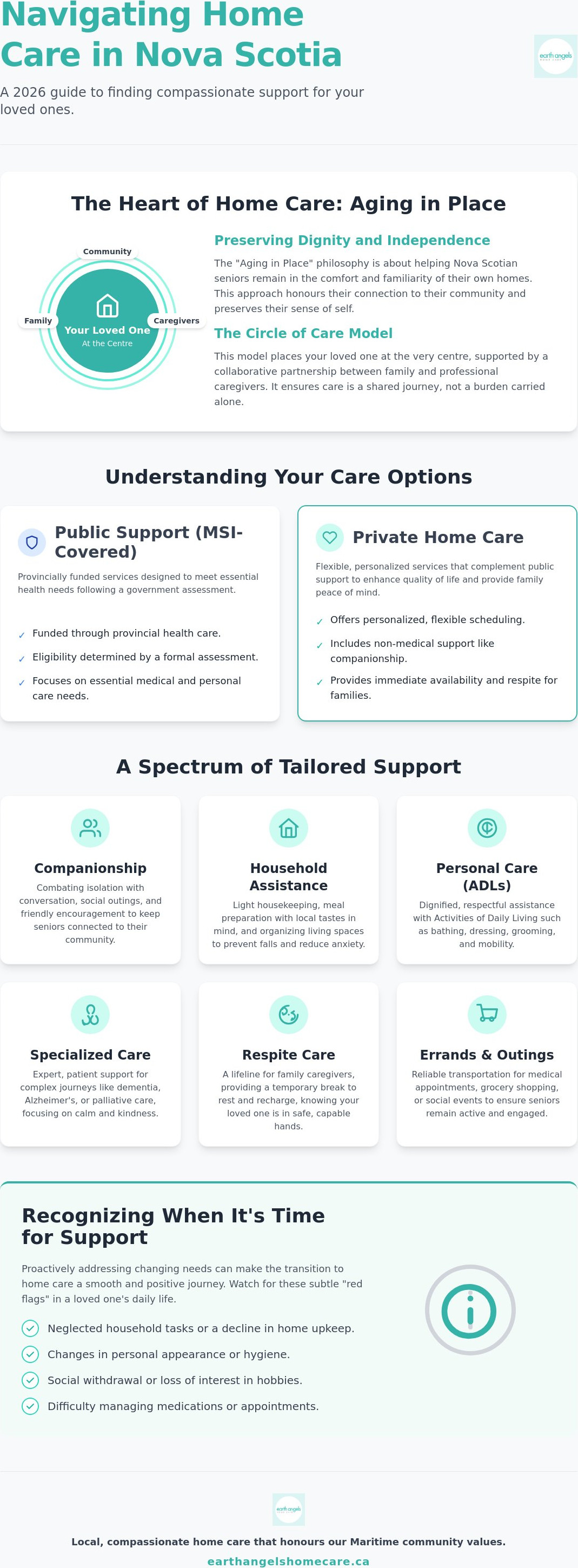
The "Aging in Place" philosophy is deeply woven into our Maritime culture. Most Nova Scotians have a profound connection to their homes, their gardens, and their local neighbours. Staying at home as long as possible isn't just about comfort; it's about preserving a person's sense of self. To make this work safely, we focus on a "Circle of Care." This model places your loved one at the centre, surrounded by a supportive partnership between family members and professional caregivers who act as trusted advisors.
The Role of Home Care in the Healthcare System
Home care serves as a vital pillar of our provincial health infrastructure. By providing high-quality support at home, we help reduce the immense pressure on hospitals in Halifax and regional centres like Truro, Bridgewater, Berwick or New Glasgow. There is a clear distinction between acute medical care, which happens in a hospital, and the long-term support provided by home care services Nova Scotia agencies offer. While hospitals focus on "fixing" a medical crisis, home care focuses on "sustaining" a high quality of life. Families across the province are increasingly choosing this path because it allows for a level of personalized attention that a busy facility simply cannot match.
Key Terminology Families Should Realize
Understanding the language of care helps you make informed decisions without feeling overwhelmed. Here are a few terms you'll encounter:
Activities of Daily Living (ADLs): These are the essential tasks of life. They include things like bathing, dressing, grooming, and moving safely around the house. Our focus is on assisting with these non-medical needs to maintain a person's dignity.
Respite Care: This is a true lifeline for family members. It provides a temporary break for the primary caregiver, allowing you to rest and recharge while knowing your loved one is in safe, capable hands.
Person-Centred Care: This means the care plan is built around the individual's unique history, preferences, and personality, rather than a rigid schedule.
By focusing on these elements, we ensure that the support provided feels less like a clinical intervention and more like a natural extension of the family's own care.
Tailored Support: From Companionship to Specialized Dementia Care
Care is rarely about a single task. It's a collection of small, meaningful moments that preserve a person's quality of life and sense of self. For some, the journey begins with simple companionship to combat the isolation many seniors feel in our province. For others, it involves more intimate personal care like help with bathing, grooming, or dressing. Choosing the right home care services Nova Scotia provides means finding a balance between physical assistance and emotional connection. We focus on the "wholeness" of the person, ensuring they feel respected and heard in their own home while giving family members the space to breathe again.
Daily Living Support and Household Assistance
Maintaining a home can become a source of stress rather than comfort as we age. We provide light housekeeping to keep living spaces safe and organized; this simple act helps prevent falls and reduces daily anxiety. Meal preparation is another cornerstone of our support. Our caregivers prepare nutritious meals that honour local Maritime tastes and specific dietary needs. Whether it's a drive to a social outing in Halifax or a medical appointment in Bridgewater, we ensure seniors stay connected to their community through reliable transportation and steady encouragement.
Specialized Care for Complex Journeys
When a diagnosis like Alzheimer's or dementia enters the picture, the needs of the family change. This specialized path requires a "calm in the storm" approach where expertise meets deep patience. Caregivers use their training to manage memory loss with kindness, focusing on what the individual can still do rather than what they've lost. You can find excellent Dementia Care Resources in Nova Scotia to help understand the provincial support network available to you as you navigate these changes.
If you're feeling the weight of these responsibilities, exploring home care options can be the first step toward finding peace of mind for your whole family. Our home care services Nova Scotia team is here to walk this path with you as a dedicated ally.
Navigating the System: Public vs. Private Home Care in NS
Understanding how to access help is often the first hurdle for families. In our province, the system is divided into two main streams: publicly funded support through the government and private care through independent agencies. Navigating the landscape of home care services Nova Scotia offers can feel like trying to solve a puzzle while you're already exhausted. It's helpful to view public care as a foundational safety net, while private care acts as a personalized bridge that fills the gaps in your loved one's daily life.
Accessing Government-Funded Support
Publicly funded home care is managed by the Nova Scotia Health Authority's Continuing Care branch. To begin this journey, you or your loved one must contact a care coordinator by calling the provincial toll-free line at 1-800-225-7225. A coordinator will then visit the home to conduct a formal assessment, evaluating health needs and safety risks to determine how many hours of support the province can provide.
While this system is a vital resource, it often faces challenges like waitlists; for context, in early 2022, over 1,200 Nova Scotians were waiting for publicly funded hours to become available.
The Advantages of Private Home Care Services
Many families choose to supplement government hours with private home care services Nova Scotia agencies provide to ensure their loved one is never left without support. Private care offers a level of flexibility that the public system simply isn't designed to match. Instead of being assigned a time slot that fits a provincial schedule, you choose the hours that work best for your family's rhythm. This ensures your parent has help when they actually need it, whether that's early morning assistance or overnight security.
Consistency is perhaps the greatest gift of private care. Rather than seeing a rotating cast of different workers, private agencies prioritize building a long-term relationship between the senior and a familiar caregiver. This bond creates a sense of emotional security and trust that is essential, especially for those living with memory loss. Private care also removes the restrictions on "non-essential" tasks. A private caregiver can spend an afternoon looking through old photo albums, taking a slow stroll through a local park, or driving to a favourite bakery; activities that nourish the soul but aren't typically covered by public assessments.
By blending these two systems, you can create a comprehensive "Circle of Care" that respects your budget while never compromising on your loved one's happiness or safety.
Recognizing the Signs and Preparing for the Transition
Watching a parent age is a journey filled with quiet observations. It often begins when you notice small, uncharacteristic changes in their daily rhythm. Perhaps the vegetable garden they once tended with pride is now overgrown, or you find expired milk tucked away in the back of the fridge. These aren't just household chores slipping through the cracks; they are gentle signals that the current way of living is becoming a burden. Recognizing these shifts early allows your family to explore home care services Nova Scotia offers before a health crisis forces a hurried decision.
10 Signs Your Loved One Might Need Support
Identifying the need for help requires looking at the "whole" person. We encourage families to look for these physical, cognitive, and environmental red flags:
Physical changes: Sudden weight loss, unexplained bruising from minor stumbles, or a decline in personal hygiene.
Cognitive shifts: Forgetting to take heart or blood pressure medications, repetitive questions, or a noticeable withdrawal from social groups and hobbies.
Environmental signals: A once-tidy home falling into disarray, piles of unopened mail or unpaid bills, and a lack of fresh food in the kitchen.
If you see these signs, it's natural to feel a wave of guilt. Many adult children feel they should be able to provide all the care themselves. However, your most important role is to be a loving daughter or son. By bringing in professional support, you aren't "giving up" on your responsibilities; you are choosing to prioritize your parent's safety and your own emotional well-being.
Making the First Week a Success
Starting the conversation about care doesn't have to be a confrontation. Approach the topic with "we" language, focusing on how support will help them stay in the home they love. Once you decide to move forward, the first week is all about building trust. We believe in "matching" caregivers to the unique personalities of our clients. If your mother loves tea and local history, her caregiver should be someone who enjoys those same stories. This turns a "service" into a meaningful relationship.
Success during this transition also relies on clear communication. Set expectations early with your agency and focus the care plan on the "colour" of life. While tasks like laundry and meal prep are essential, the joy comes from rediscovering hobbies and maintaining social connections. If you're ready to see how a personalized plan can restore peace to your household, you can request a compassionate consultation with our local team today. Transitioning to home care services Nova Scotia families trust is the first step toward a safer, more vibrant future for your loved one.
Why Local Matters: The Earth Angels Approach to Community Care
There is a unique comfort in knowing that the person stepping into your home understands the rhythm of life in our province. For over 20 years, Earth Angels Home Care has focused on being more than just a provider; we act as a "Compassionate Expert" and a steady ally for families. Choosing home care services Nova Scotia residents trust means finding a team that values local legacy and family bonds as much as you do. Our caregivers aren't just staff; they're neighbours who've been recruited and trained to honour the specific Maritime values of kindness, hard work, and community connection.
This local approach allows us to provide a "calm in the storm" for families facing difficult transitions. Earth Angels Home Care has spent two decades refining a model of care that prioritizes the emotional security of the senior while offering profound relief to their children. By focusing on the "wholeness" of the individual, we ensure that their physical needs are met with professional expertise, while their social and emotional requirements are nurtured with genuine warmth. This dedicated focus is what creates true peace of mind, knowing your loved one is supported by a team that is deeply invested in the well-being of our community.
Serving Our Communities Across Nova Scotia
Our roots run deep across the province, with dedicated teams serving families in Halifax, Truro, New Glasgow, Antigonish, Amherst, Berwick and Bridgewater. Whether your loved one is in a bustling urban centre or a quiet rural hub on the South Shore, our goal remains the same: helping them age safely in the place they love. Earth Angels Home Care doesn't work in isolation. Instead, we partner with local healthcare providers and community organizations to ensure every care transition is as seamless and stable as possible. This interconnectedness allows us to be a reliable guide for families, helping you navigate the complexities of aging with confidence and grace.
Your Next Steps Toward Peace of Mind
Taking the first step toward external support is often the hardest part of the journey. Earth Angels Home Care has designed its process to be as gentle and unhurried as a conversation with a trusted advisor. It begins with a free, no-obligation consultation where we listen to your story and understand your family's unique preferences. During this initial meeting, we'll discuss your loved one's daily needs, their personality, and how we can best support your role as a family member rather than a coordinator.
We'll walk through the creation of a flexible care plan that can evolve as needs change, ensuring there's always a clear path forward. This is your opportunity to ask questions, share concerns, and feel the reassurance that comes from having a professional partner by your side. Let us help you find the right care for your family. Transitioning to home care services Nova Scotia families rely on is about more than just safety; it's about giving your loved one the dignity they deserve and giving yourself the time to simply be their family again.
Restoring Balance to Your Family Life
Choosing the right path for your loved one's care is an act of profound love. You've learned how to navigate the provincial system, identify the subtle signs that extra support is needed, and understand the deep value of choosing a local partner who shares your Maritime values. By blending government assistance with private home care services Nova Scotia families can rely on, you ensure your parent stays safe while you regain your essential role as a daughter or son. It's about moving from a place of exhaustion to a place of connection.
With over 20 years of experience serving communities from Halifax to Truro and beyond, our specialized dementia and palliative care teams are here to provide the stability your household needs. We're trusted by families across the province to act as a wise guide through these sensitive life transitions, replacing anxiety with a sense of belonging and wholeness. You don't have to navigate these complex decisions alone; a supportive partnership is just a conversation away.
Book a Free Care Consultation for Your Loved One
Take this moment to breathe and realize that help is available. We're here to help you find the peace of mind and safety your family deserves.
Frequently Asked Questions
What is the difference between a home care agency and a nursing home?
A home care agency provides support from 1 hour up to 24 hours a day within your own house to help you maintain independence, whereas a nursing home is a residential facility providing 24/7 clinical supervision. Home care focuses on assisting with daily tasks and companionship in a familiar environment. Nursing homes are designed for individuals with complex medical needs that require around-the-clock professional nursing intervention in a centralized setting.
Can I get home care if my parent lives in a rural part of Nova Scotia?
Yes, support is available across the province, including rural hubs like Antigonish, Truro, New Glasgow, Berwick, Amherst and the South Shore. Local providers understand the importance of reaching seniors in smaller communities to ensure they can age in place safely. This "local neighbour" approach ensures that families living outside of Halifax still have access to the same high-quality, compassionate support as those in the city.
What happens if my parent refuses to let a caregiver in the house?
Resistance is a very natural response to a perceived loss of independence, and we find that a slow, gentle introduction is usually the best approach. By focusing on a "personality match" first, the caregiver can enter the home as a helpful visitor rather than a clinical provider. Over time, as trust is built through small acts of kindness and shared stories, most seniors begin to look forward to these visits.
Can home care services help with dementia or Alzheimer's?
Yes, specialized home care services Nova Scotia providers offer include dedicated support for those living with various forms of memory loss. Caregivers receive specific training to manage the unique challenges of Alzheimer's with patience and empathy. They focus on creating a "calm in the storm" by maintaining familiar routines and ensuring the environment remains safe and supportive for the individual.
How quickly can home care services start after an assessment?
Private care can often begin within a few hours to days of an initial family consultation, whereas publicly funded services may involve a waitlist depending on the current demand in your specific region. In early 2022, there were over 1,200 people on the provincial waitlist for public support. Because private agencies operate independently of these waitlists, they can provide a much faster bridge to the relief your family needs.


